

Neighboring.
Small Acts of Co-Regulation in Big, Overwhelming Times

A funny thing happened on the way to the revolution.
We learned that sometimes all it takes is a bunch of people moving their feet — to the grocery store, to the donation drop-off, to the bus stops, to the street corners.
It was −10 degrees last Friday. We had the day off from school and work, a reprieve from the act of slogging through normalcy, trying to pretend the air wasn’t thick with angst. But the sun was out, and I admired its bright defiance against the temperature — a stubborn refusal to hide behind the clouds.
The city hummed with plans to channel our collective distress. My husband went downtown, handwarmers in his boots and a playlist of Pete Seeger. Tens of thousands of people were walking, drumming, singing — slowly, peacefully moving through the streets together.
Cold but fired up.
Angry but composed.
Grieving but resolute.
I stayed home with the kids and we showed up on our own little corner instead. Even there, almost 75 people gathered. We stayed until the ice crystals on our eyelashes told us it was time to go back inside.
On the walk home I told my girls, “Look at how tough you are!! True Minnesotans. You’ll remember this your whole life!”
I meant the cold.
And the profound moment we find ourselves in.
By Saturday morning, the alerts came fast — renewed shock, renewed grief, renewed unrest. Another person dead.
Minneapolis is a small town masquerading as a city. I didn’t hear it from a news outlet. I heard it from my gym group text.
Parenting during crisis has a strange split-screen quality. Your heart is pounding, but your voice is calm. You are looking for that missing pink sock while your nervous system is on the fritz. You are asking, “Jelly or cream cheese on your bagel?” while your phone is pinging like crazy, filling you with dread.
You would think I’d be used to this by now, having lived through 2020.
I’m not.
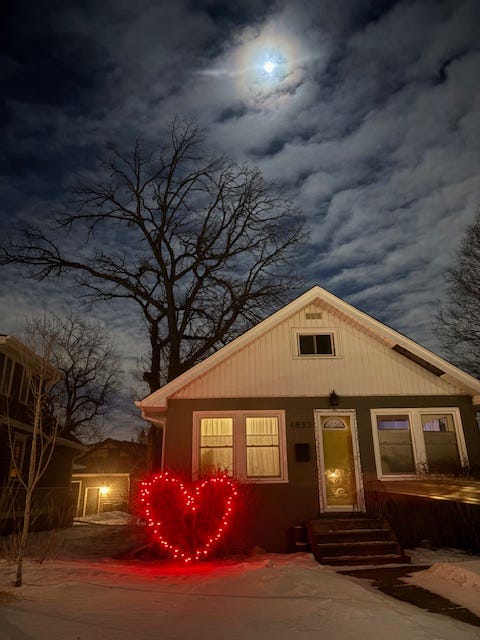
Saturday evening, shock turned into motion. I went downstairs to the candle cabinet. Leftover holiday tapers. Cardboard. Kitchen scissors.
“Which one would you like to carry?” I asked the kids with surprising enthusiasm — the kind that comes when your body decides before your brain does.
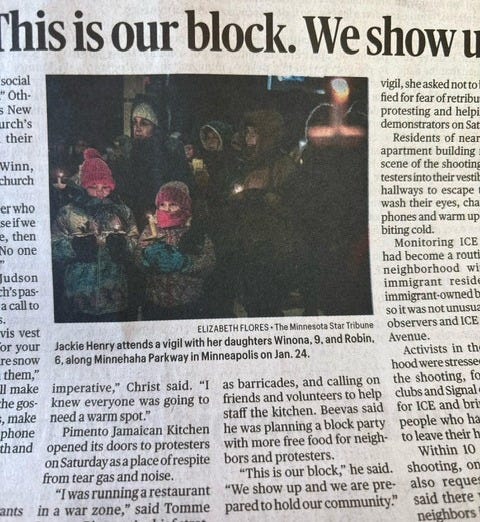
We made wax drip guards. We bundled up. We walked back to the corner — this time not chanting, not cheering — just holding candles against the wind.
The vigil was exquisitely sad and exquisitely beautiful.
My youngest stood close, guarding my flame with her bright blue mittens, carefully dipping her candle to occasionally relight mine.
“I’m taking care of you, Mom,” she said.
My tears froze quickly on my cheeks, and my heart was a little more still.
A photographer approached us after a wobbly but earnest rendition of We Shall Overcome.
“What are your names?” she asked my 9-year-old daughter. “Why was it important for you to be here tonight?”
“To support people,” she said simply.
The next day our picture was in the paper — one of many tiny clusters across the city, small circles of candlelight on ordinary corners.
I’ve since heard people call this Minneapolis style of activism neighboring.
I love that.
Not grandstanding.
Not posturing.
Not perfect messaging.
Just showing up near where you stand.
When things feel too big, the mind tries to go bigger — more analysis, more information, more arguments, more certainty-seeking.
But the nervous system needs the opposite direction. It settles through small, embodied, relational acts.
Psychology has a name for this — co-regulation — but most of us just call it being with people. Moving together. Standing together. Doing one small good thing side by side.
Neighboring.
So the next time the news or the moment feels too big for your chest, don’t ask first what you should think.
Move your feet.
Stand near others.
Hold a light.
Do the next small good thing.
Terrific essay! Thoughtful , passionate, promising.
So proud of you all. Stay strong, keep showing up for each other. I’ll be protesting again this weekend in Saratoga County. Liberty is earned, not given, requiring constant courage, action, and sacrifice to defend against oppression.