

Running From Myself
When a 10K turns out to be more than 6.2 miles

I had been nervous all week. As race day approached, I recognized the restlessness, the chest flutters—old ambassadors of anxiety come calling. It wasn’t the newness of it; Twin Cities Marathon weekend—with its mix of races and traditions—has been part of my fall ritual for years. The long runs that start in morning darkness and end in hot pink dawn. The careful calculations of layers to balance the chill of sunrise with the heat of midday. The way the whole city buzzes with adrenaline—ready to cheer, to run, or both.
Maybe it was the heaviness of the school year’s start—the community violence, the big emotions in kid-sized bodies that always accompany transition. Maybe it was the realization that the space I’d hoped would open once the kids went back to school had already filled itself—with the work I’d ignored all summer and the home projects I chased to reassert control over something.
Or maybe it was the heat wave that stretched through September into October, my Birkenstocks still by the back door, my sweatshirts and jeans untouched on the shelf—signs that time had stalled while the calendar insisted on marching forward. Summer unwilling to move on while I was ready to let it go.
“Maybe I’ll just run the 5K with the kids,” I told my husband midweek. “Leave the longer one for someone who actually trained.”
But then came the internal rebuttals:
What if they catch me with the wrong bib and I can’t run at all?
What if I regret not doing the longer race?
I waffled all week, my mind a ping-pong match between two unremarkable options. That’s usually my tell—when indecision creeps in, something deeper is stirring.
Knowing this agitation would have me awake early anyway, I got up in the dark on Saturday morning and made my way to the 10K start. The buzzing in my chest had an edge to it.
I love the start line—the rush of adrenaline when you know you’ve put in the work, when your body feels like it’s waiting for permission to prove itself. But this time, I knew I hadn’t. After a bout of Covid, a jam-packed summer and regular gym classes that always left me just sore enough, I’d been avoiding the discipline of weekly long runs. The extra effort felt like it might be the thing that finally tipped me over the edge.
And now, the very manageable distance of 6.2 miles felt daunting, the distance itself a cover for something else.
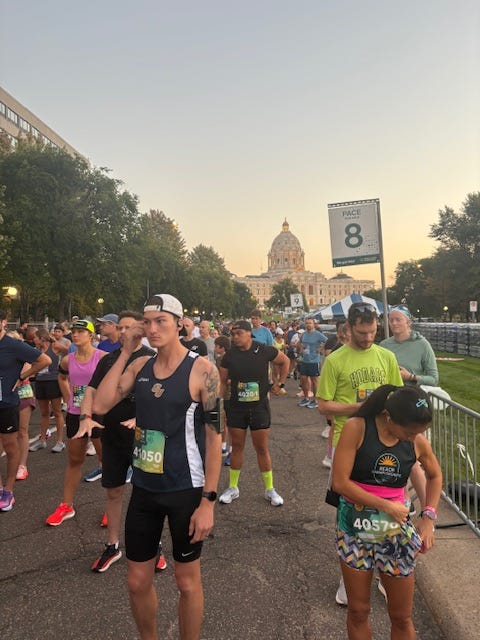
The first hill hit right away, two-tenths of a mile straight up. I waited for my breath to even out when the pavement leveled, but it never did. Once my lungs started to tighten, my brain followed. Panic sensations led to panic thoughts, which led to more panic sensations—an old loop, the worn grooves of my anxious mind.
By mile two, my pace was fine, but my mind wasn’t. By mile three, I walked to the hydration station, desperate for a lukewarm Nuun to work a miracle.
And that’s when the comparisons began.
Look at her pace. He’s older. She’s younger. They’re not even breathing hard.
Then the self-blame:
You didn’t train. You didn’t prioritize. You got lazy. You’re not that good.
Then the rationalizing:
The weather. The schedule. The kids.
And finally—around mile five—the grief.
Tears came hot and unexpected. I felt embarrassed, wiping them away before anyone could see. It’s just a race, I scolded myself. Not even the 10-mile, not even the marathon. Look at all these other people not crying.
But grief has its own pace. It doesn’t care what race you signed up for or how well you trained. It catches up when your body finally slows down enough to feel it.
Psychologists call this catharsis—the emotional release that comes when our defenses tire out and the feelings we’ve been holding make their way to the surface. Movement often loosens what our minds have been gripping too tightly. Avoidance can disguise itself as productivity (check), as busyness (check), even as training for the next race (not yet). But the body keeps score, and eventually, it demands to be heard.
I’m still sorting through what I was grieving. My sense is that it was a mountain made of toothpicks—stresses and unspoken worries, stacked one at a time until their collective weight finally gave way.
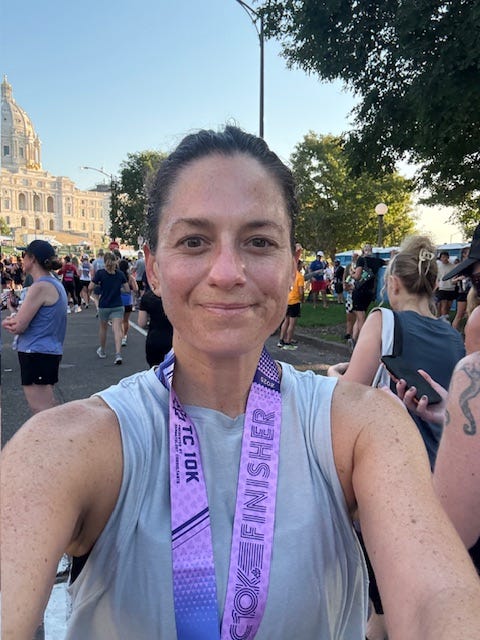
As I turned down the last hill, the St. Paul Cathedral on my left, the Capitol gleaming ahead, I tried to return to my body—not in overwhelm, but in a clumsy lurch toward gratitude. My legs carried me even when my mind wanted to quit. My lungs kept working through the burn. My heart—tight, flooded, human—kept me moving forward.
I thought about my daughters waiting at the finish line, wondering how they might read my face. Maybe I didn’t need to look inspirational or strong. Maybe my overheated, tear-stained face crossing the finish line was enough—for them, and for me.
There are races you can train for—and then there are the ones that train you. The ones that strip away performance, comparison, and avoidance until all that’s left is the quiet rhythm of your feet, carrying you through the ache toward something that looks a lot like acceptance.
.
I was in tears reading this, recognizing so intimately the feelings you describe. Thank you for writing and sharing it.
You are amazing Jackie! Love your writing. Thank you for sharing your experience.🩵🩵🩵