Stay Open.
The dangers of closing ourselves off—literally and figuratively.

“Mom, are we close to Annunciation?” my nine-year-old’s voice piped up, taking her turn in the backseat while her ten-year-old sister claimed the front.
“Yeah, just a few blocks away. Do you want to stop by?” I asked, tossing our bag chair and soccer shoes into the van. Two blond heads nodded yes.
We had just finished a Saturday morning on the soccer field—a September ritual. While they warmed up before the game, I walked the dog through nearby neighborhoods, overwhelmed by the blue and green ribbons tied around trees. My mind kept backtracking to the shooting not yet two weeks earlier that claimed two young lives. I tried to reconcile the bucolic scene of grade-schoolers chasing soccer balls with the knowledge that some of them had been directly impacted—and most would soon endure more active-shooter drills at school.
I tried not to linger on how Harper or Fletcher might have been scheduled to play there this very weekend, but instead their families were planning funerals.
Buckets of blooms
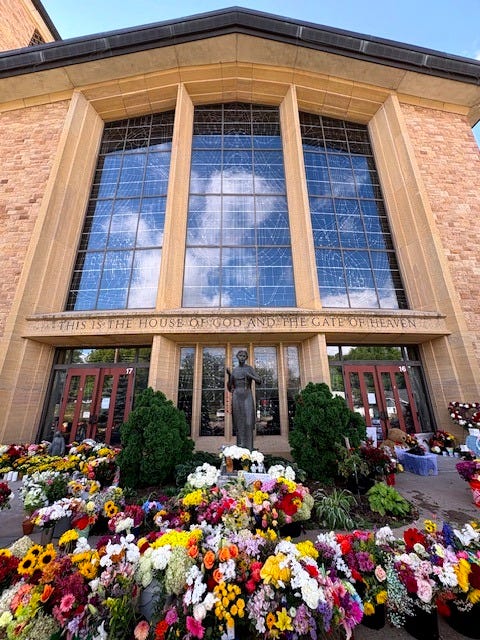
When we arrived at the church, I held my daughters’ hands as we walked toward rows of five-gallon buckets overflowing with blooms—the pure beauty overwhelming.
We wandered slowly among just a few others paying their respects, pointing out our favorite flowers, marveling at varieties I’d never seen. Invoices were still tucked into stems stamped with zip codes from all across the country.
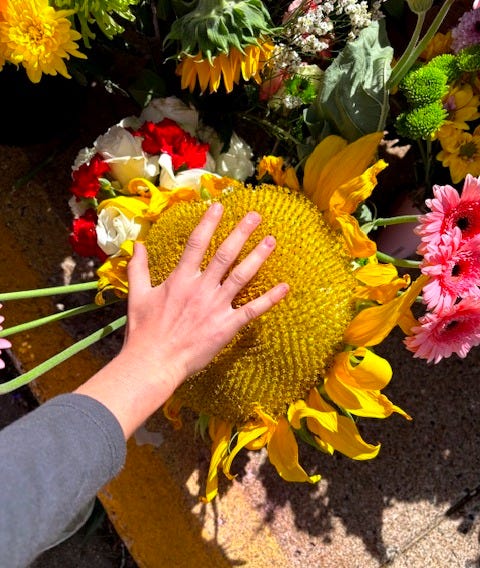
“Mom, look!” my nine-year-old crouched down, stretching her pinkies to measure what she declared “the biggest sunflower ever.”
“Take a picture for Dad!” she said, and I did.
The day before, I had stopped by alone, pulled in by what felt like a magnetic force. I hesitated at first, afraid of being an interloper—a trauma leech feeding on violence. But as soon as I parked and crossed the street, the sadness was unavoidable—a weight pressing down, grief pooled in the air.
This time, I came less as a mourner and more as a steady shepherd for my kids. I didn’t push reflection, just answered questions and let curiosity (and some rumbling tummies) guide the pace. They circled the two crosses covered in handwritten inscriptions to Harper and Fletcher. I glanced at one note I hadn’t seen before: “Thank you for being a good friend to [my son],” written in a mother’s hand.
Tears burned hot in my eyes. I wondered if I had made a mistake bringing them—pretending I could be the sturdy one.
I noticed the caretaker, the same older woman I’d seen before, stylish and composed, moving with deft hands to pluck wilted blooms, arrange candles, and clear paths for visitors.
And I marveled at how open the space remained. With the exception of the church interior, nothing was barricaded or cordoned off. It felt like a quiet but bold proclamation: we will not fold; we will not close our holy grounds; we will not yield to evil.
Locked doors
The next morning, at Mass at our own parish, a piece of printer paper taped to the door greeted us:
Doors will lock at 9 a.m. and 11 a.m.! Door 1 will remain open.
I tugged it open at 10:59 and ushered the kids inside.
“Welcome,” our faith leader, Gabrielle, said gently. “I’m sure you’ve noticed we have new protocols in response to the incident in our community. We’re not sure what the best approach is, but we wanted to try something. We welcome your feedback. And now let’s take a moment of silence.”
I bowed my head, feeling the pain behind her words—the helplessness, the desperate need to do something, anything.
And yet, anger rose in my cheeks.
We’ve tried locking doors. Installing metal detectors in schools. Buzzers to drop off a lunchbox. Practicing more lockdown drills than fire drills.
Is our only choice to keep closing off, hoping to stay one step ahead of innovation by those socially isolated, mentally unstable, and armed with military-style weapons?
The temptation to close
Because closure is not only physical. It’s also emotional and spiritual.
We close ourselves off to difficult conversations, to political disagreements, to grief that feels unbearable. We numb, avoid, barricade.
But what if the call in this moment is to do the opposite?
To remain openhearted—to let ourselves feel, to argue and wrestle with ideas, to grieve together, to be brave enough not to shut down.
Psychologically, when trauma or fear overwhelms us, many of us unconsciously protect ourselves through dissociation—a kind of numbing or shutting down of our awareness. It’s the mind’s way of saying, this is too much.
Sometimes that looks like distraction, avoidance, or going on autopilot. These strategies keep us afloat in the short term, but they can also close us off from feeling, connecting, and healing.
The harder and braver choice is to remain openhearted: to let ourselves feel grief, to talk across differences, to stay tender with one another, even when it hurts.
Staying open
Because in these two weeks, I’ve seen both pain and tenderness braided together: tight hugs, casseroles on doorsteps, handmade signs, ribbons, donations, community prayers, tears, flowers.
If you have an idea, try it. Let’s do it. Anything!
On Monday, four Minnesota law enforcement officials wrote an op-ed calling for adequate mental health funding, restrictions on assault weapons, and more school resource officers. Yes, keep it coming. All of it. As those officers wrote, not doing anything is still a decision.
I’m deciding to stay open.
I’m too tired to wrap this in ideology. Too focused on holding onto the humanity I’ve witnessed—and mourning the humanity that was taken.
And what I’ve witnessed in my community these past two weeks is profound sadness, yes—but also profound openness, courage, and beauty.
We must not let that drift away on the hamster wheel of life.
We cannot close off—our doors, our politics, our hearts.
We must stay open. We must stay brave.